

On April 21, Microsoft’s Threat Intelligence team published a document that portends the end of the “Default Human” in the workplace.
The document is titled, in technical bulletin-style, “Detection strategies across cloud and identities against infiltrating IT workers.” But a read between the banal lines reveals something more chilling: the person you just hired, interviewed, and welcomed into your Slack channel might not exist.
The Infiltration of the Interview
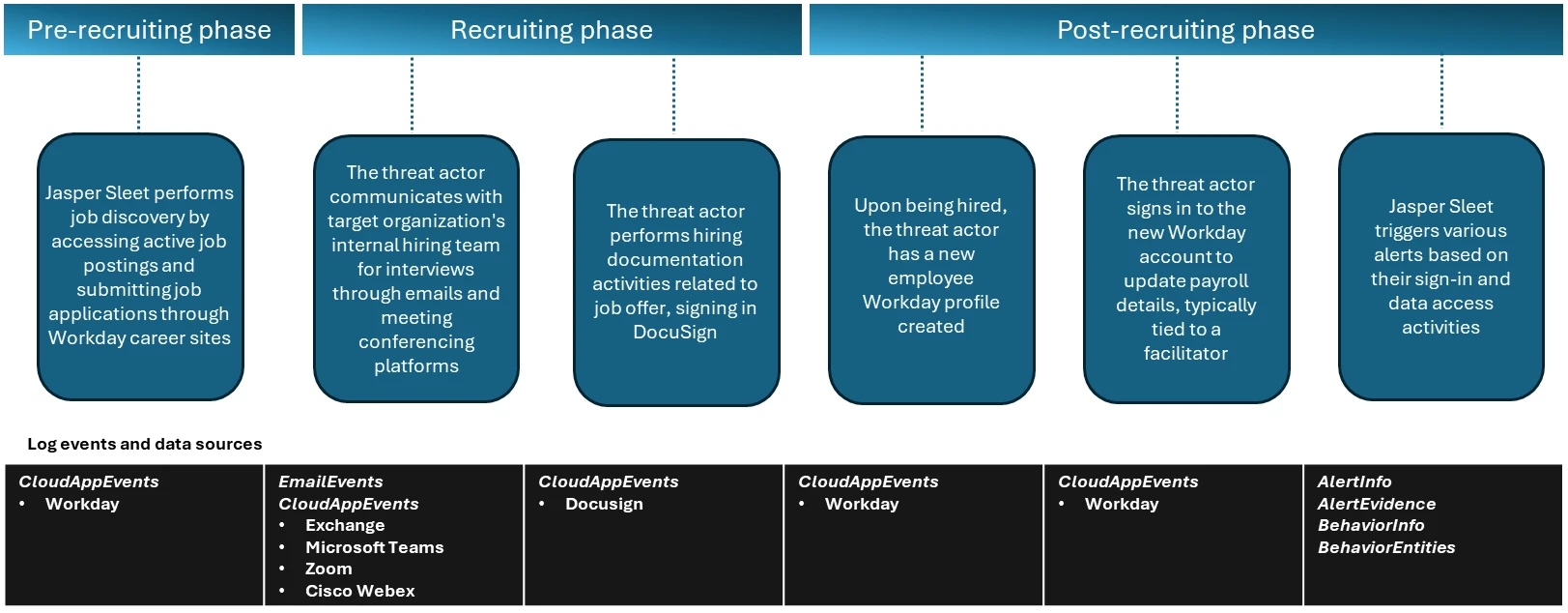
We are used to the idea of hackers “breaking in.” But the North Korean state actor known as “Jasper Sleet” (I need to find out how they come up with these names) has found a more efficient way: they are “hiring in.”
Using generative AI to craft the perfect resume and “liveness” tools to pass video interviews on Teams and Zoom, these operatives are infiltrating Western companies through standard hiring portals like Workday. They aren’t looking to crash the system; they are looking for a paycheck. And the FBI and Treasury have confirmed that this corporate compensation directly funds North Korea’s weapons program. (Watch this superb Bloomberg short documentary on how this scam works.)
Forget calling this a “hack.” It is a systemic hijacking of human trust.
The Rise of the Reverse Turing Test
For a CISO, this is a nightmare of “Behavioral Telemetry.” You are no longer looking for malicious code; you are looking for malicious presence. Microsoft’s advisory lists signals like VPN anomalies and API call patterns in recruiting software as the new red flags. But for the rest of us, it signals the arrival of the “Reverse Turing Test.” In the original Turing Test, a machine had to prove it could think. In the Reverse Turing Test, we humans are being forced to prove we are biological entities just to earn a living. We are moving from a world where we assume a coworker is real until proven otherwise, to a world where we are all “ghosts” until we provide a biometric receipt for our existence.
The “Shadow Casualty”
This is where the security problem could well become a problem for humans seeking gainful employment.
The signals Microsoft uses to flag a North Korean operative in Pyongyang — non-standard hours, unfamiliar IDs, unreliable connections — are the exact same signals generated by a legitimate remote developer in Lagos, a parent in Manila, or a freelancer in Bogotá.
When we build a digital “Human Perimeter” to keep out the ghosts, who gets caught in the dragnet?
• The CISO failure: A fake worker gets hired and exfiltrates data.
• The Human failure: A real, qualified worker is “algorithmically ghosted” and never told why, because their digital footprint looked too “synthetic” to an automated filter.
Why This Matters for “The Only Human in the Room”
In my documentary-in-progress, we’re looking to capture the moment the mask slips. We are filming the forensics of presence, seeking out the sub-pixel shimmering and the auditory “glitches” that reveal when a human has been replaced by a machine.
The Microsoft post proves that the “Only Human in the Room” is now an HR reality. Whether you are the hiring manager being charmed by an AI-generated mask, or the legitimate worker being locked out by a defensive algorithm, this “Reality Gap” is an emergent economic barrier. We aren’t just defending our servers. We are defending the very possibility of knowing whether there’s an authenticated human in that other box on the screen truly seeking a new professional opportunity.