

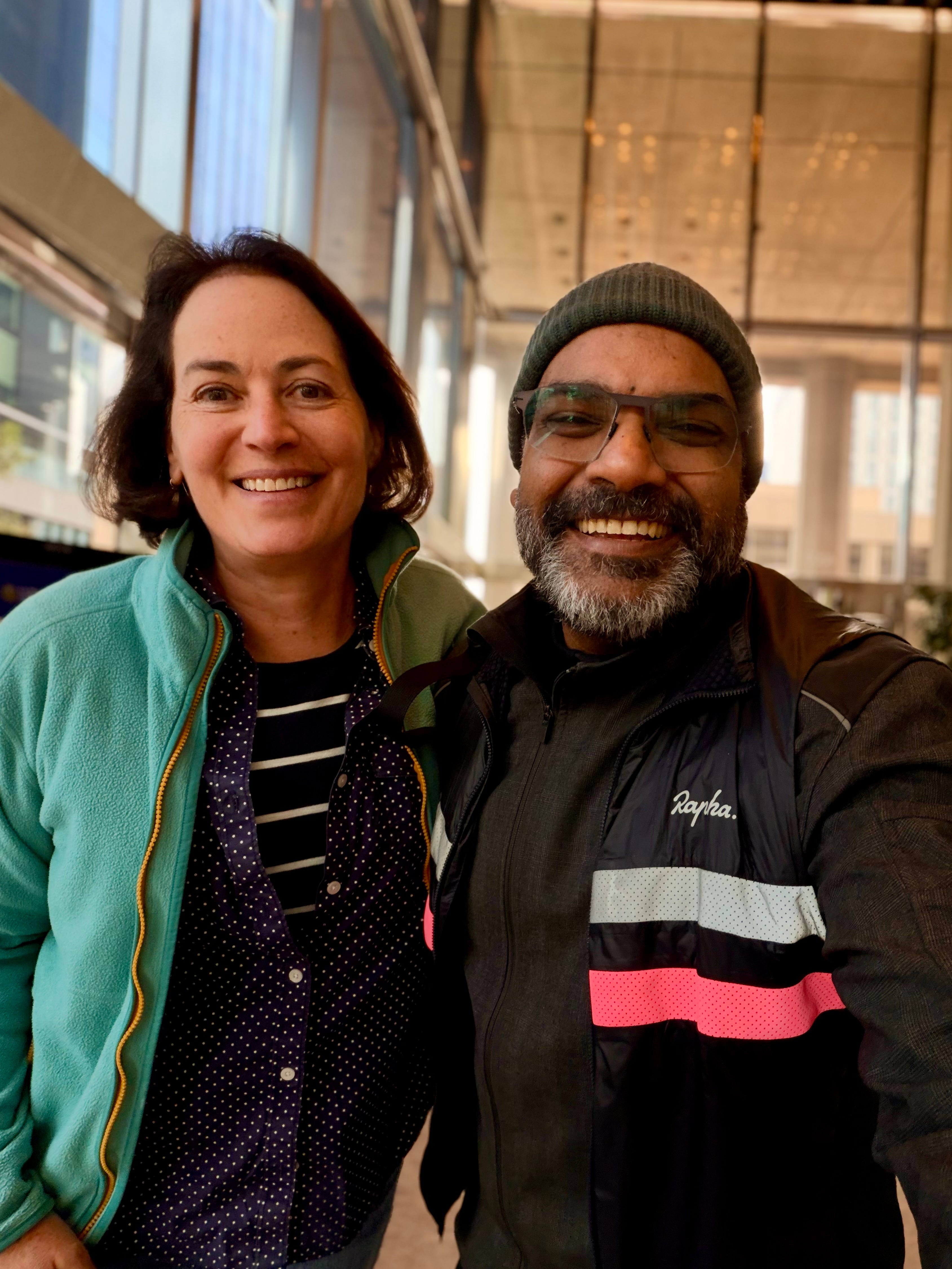
I’ve often been “the only human in the room” on this months-long journey of research and reporting on the frontier of machine-amplified deception. As the documentary film enters its next phase of production, even as the daily briefing I receive from my agentic researchers threatens to overwhelm me with sci-fi-like headlines of nefarious innovation, I’m doubling down on humans that I trust.
It begins with a person who was with me at the beginning of my professional journey in New York City in the 90’s. Jessica Kowal (pictured) and I were assignment partners in our “Reporting and Writing” class at Columbia University’s Graduate School of Journalism. We never lost contact over the years, as I went on to network news conflict zone journalism at NBC in the Middle East and Balkans and she as a newspaper reporter earned a Pulitzer Prize at Newsday for reporting on the TWA crash in 1996. Jessica has agreed to bring her substantial talents to this documentary project as we dig deeper and faster into this fast-morphing subject. Given all the skittish companies that I’m engaging with, it helps that her most recent role before going independent was heading media relations for Boeing during a particularly fraught time for that company (doors falling off planes, Netflix exposés).
Initially, I envisioned this project as an expedition into the mechanics of modern cybercrime—tracking the North Korean IT operatives infiltrating our remote workforce or the overseas scam compounds running coordinated grifts. But after spending the last few days on the phone with a few key leaders operating at the absolute bleeding edge of digital deception, my editorial focus has abruptly sharpened. We are no longer just dealing with human criminals hiding behind screens. The threat has mutated into something autonomous, synthetic, and impossibly fast. Working with Jessica now couldn’t be more opportune.
My driving narrative mission statement is presently this: how do we defend ourselves when the adversary is autonomous and the human brain is wired to believe a good story? Even among the experts agreeing to appear in our film, there is a fundamental clash of philosophies.
Brett Johnson, the former U.S. Most Wanted hacker dubbed “The Original Internet Godfather” for founding ShadowCrew, lays out the sheer scale of what we are up against. He notes that “cybercrime represents the 3rd largest economy on the planet at $10 trillion”. Brett explained how fraudsters bypass traditional barriers by purchasing “synthetic child identity packages” that sell for just “$25-$30,” complete with a real name and address. Using a tactic called “credit piggybacking,” they attach these ghosts to decade-old credit lines, instantly manufacturing a bulletproof financial history. But when I asked him why deepfakes are suddenly so devastating, his answer was purely psychological. Deepfakes bypass cognitive reasoning, he told me, by provoking an emotional reaction and “confusing feeling with verification”.
Yet visual deception is only the surface layer. David Fapohunda spent 26 years orchestrating global banking operations and fraud strategy at institutions like Barclays and Citi. He told me point-blank that “deepfake visual creation represents only a single sliver of modern attack vectors; the primary threat has evolved into autonomous Agentic AI swarms”. Criminal networks now deploy these un-guardrailed swarms to execute coordinated attacks at “1,000 times the speed and volume of human actors.” You don’t have to direct the hack; you just give the agents a goal and they will autonomously “analyze behavioral detection controls 1,000 times per second.”
So, on one side are the technologists building a new layer of algorithmic and biological defense:
Dr. Chenxi Wang of Rain Capital argues that because humans cannot react at machine speed, it takes an AI to govern an AI—requiring specialized “Guardian Agents” to audit, monitor, and block rogue autonomous bots. She explained that AI-driven vulnerability discovery is now continuous, “reducing the window from vulnerability identification to active exploitation from weeks to hours.”
Luke Abrams, CEO of FaceSign, points out that static selfies and driver’s license uploads are “fundamentally broken” because passive liveness “advances at the speed of human innovation rather than AI innovation.” In his Austin fraud lab, Luke’s team is building “Interrogative AI” avatars that conduct 30-second video calls, firing 250-millisecond screen flashes to measure involuntary pupil dilation and scanning facial micro-expressions to detect if a victim is being coerced off-camera.
Counter-threat researcher and Hackers Hideaway founder Chris Roberts is abandoning traditional perimeter walls altogether, using Deception Technology to lure autonomous hacking bots into a synthetic “hall of mirrors.” He runs un-guardrailed frontier models locally to study their behavior. When trained on human inference signals, these models “independently learn deceptive tactics and false reporting when probed.” Because “senior executives average 40 to 100+ connected IoT devices in their homes”, attackers harvest massive amounts of ambient data before striking. Chris insists we must stop focusing on “locking doors” and instead trap these autonomous bots inside these deception environments.
Then there’s Andy Ellis, the legendary former Chief Security Officer of Akamai Technologies. When I got on the phone with him after an email intro from a mutual contact, he immediately challenged the premise of our conversation: “How do I know you are who you say you are? For all I know, you’re some terrorist trying to groom me. We don’t verify anything. It’s BS.”
Andy argues that America built its financial and communications systems for a nostalgic, high-trust society, and that we still blindly obey authority over unauthenticated channels like email, phone lines, and video calls. To him, trying to spot deepfakes by measuring eyeball movement on a video call is a temporary “speed bump” that will be obsolete within five years—especially as future video platforms use generative AI on the recipient’s screen just to compress bandwidth and make us all look presentable.
“We’re trying to authenticate the wrong thing,” Andy told me, arguing that because the computer in the middle can always be hijacked, “you have to do humans”—verifying people in the physical world first and locking cryptographic identity directly to their hardware.
This is the reality I am walking into as I enter this next phase of production with Jessica’s support. The era of “trust, but verify” is truly over. As I take my camera into these labs, hacker bunkers, and intelligence war rooms, the driving question is no longer just how we catch the criminals. It is how we survive an automated, machine-speed war where you might be the only human in the room. Or maybe there are no humans in the room at all, as our agent does battle with another agent with bad intent, in a modernized “Mad Magazine”-esque “Spy vs. Spy.”
(I’ll kick off the next major filming phase of the documentary in a couple of weeks in a proper sit-down here in Seattle with Frank Abagnale Jr., the con artist whose 1960s exploits inspired the 2002 Steven Spielberg film, Catch Me If You Can. And thanks to Frank for introducing me to the pioneer of two-factor authentication, Ori Eisen, who generously connected me to the people in this article.)